September 23, 2026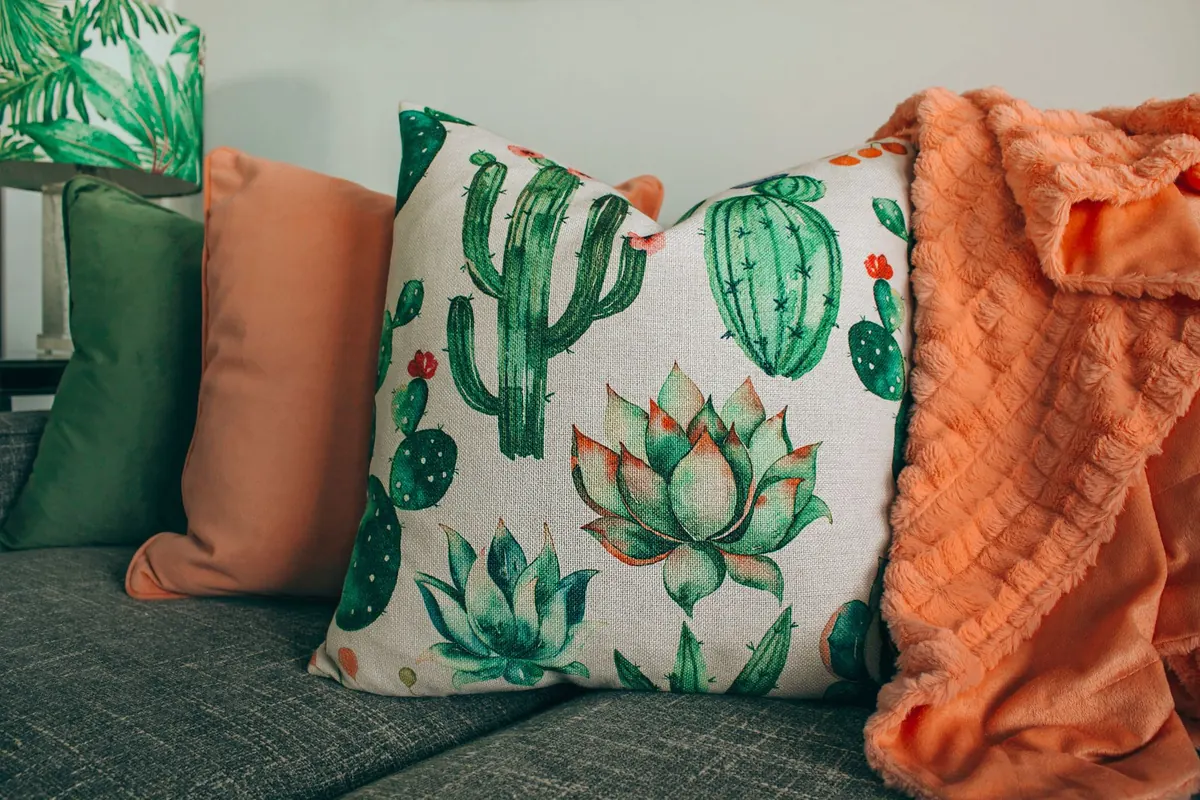
Throw pillows are the quickest way to make a room feel finished, but they are also the easiest place to get stuck. You find a pattern you love, bring it home, and suddenly the sofa looks busier than you expected. The good news is that mixing pillows is not about having a natural eye. It is about a few repeatable decisions: size, color, pattern, and texture.
Start with what you already own. Pull every pillow off the sofa or bed and place them in a pile. Then sort them by size and color. That pile is your raw material. From there, you can build a combination that looks collected rather than purchased in one trip.
Start with Size and Scale, Not Color
Size comes first because a beautiful pillow in the wrong scale will never look right. A deep three-seat sofa can handle 20-inch to 22-inch squares. A slim accent chair usually looks better with a 16-inch or 18-inch pillow, or a small lumbar. On a bed, Euro shams create the back layer, standard pillows sit in front, and a lumbar or two adds the final accent.
Odd numbers tend to look more relaxed. Even numbers look more formal and symmetrical. Neither is wrong, but odd numbers give you more room to vary size and pattern without the arrangement feeling stiff.
A quick starting formula
- Large sofa: two 22-inch squares at the back corners, two 18-inch squares in front, and one 12x20 lumbar in the center.
- Loveseat: two 18-inch squares and one lumbar, or three 16-inch squares.
- Accent chair: one 16-inch or 18-inch square, or a single lumbar.
- Queen or king bed: two Euro shams, two standard pillows, and one or two accent pillows in front.
If your sofa is small, do not force five pillows onto it. Three well-scaled pillows will look better than five crowded ones. The same goes for a bed: layers should feel generous, not suffocating.
Choose a Color Story You Can Repeat
Before you shop, pick three colors. One should be dominant, one secondary, and one accent. The easiest place to find them is in a rug, a piece of art, or a curtain panel you already love. If your sofa is a neutral like oatmeal, charcoal, or cream, the pillows can carry the color. If your sofa is already bold, keep the pillows mostly solid and pull one or two colors from the sofa itself.
A simple example: an oatmeal sofa, a navy-and-rust rug, and a cream wall. Use navy as the secondary color, rust as the accent, and cream as the quiet base. Two navy pillows, one rust pillow, and one textured cream lumbar will feel intentional without matching too perfectly.
Repeat each color at least twice in the arrangement. A single rust pillow can look stranded. Two rust accents in different patterns or textures tie the group together. This is the same principle as the 60-30-10 rule used in interior design: roughly 60 percent dominant color, 30 percent secondary, and 10 percent accent. You do not need to measure it. Just use it as a gut check.
Mix Patterns by Scale, Not by Theme
Most pillow mistakes happen when every pattern is the same size. A large floral, a large geometric, and a large stripe will fight each other. A large floral, a medium stripe, and a small dot will work because your eye can separate them.
Use one bold pattern, one medium pattern, and one small pattern. Then add a solid or a textured solid to give the group a place to rest. The solid is not boring. It is the pause between the patterns. If you want to include a second bold pattern, repeat a color from the first one so they relate.
Pattern pairings that work
- Large floral + medium stripe + small dot + solid linen
- Geometric + abstract watercolor + boucle solid
- Plaid + small animal print + leather or velvet solid
- Ikat + thin stripe + chunky knit solid
Keep pattern types different, but keep colors consistent. A navy stripe, a navy floral, and a navy geometric can live together because the color repeats. If the colors are all different, the patterns will feel chaotic even if the scales are correct.
Add Texture and Get the Fill Right
Texture is what makes a pillow arrangement feel rich instead of flat. Mix at least two textures in every group. Velvet next to linen, boucle next to cotton canvas, leather next to wool. Shiny with matte. Smooth with nubby. If you are using mostly solid pillows, texture becomes your main source of interest.
Fill matters too. A pillow cover needs an insert that is slightly larger than the cover to look full. A 20-inch cover usually looks best with a 22-inch insert. Down and down-alternative inserts give a soft, relaxed shape. Polyester inserts are firmer and hold a crisp edge. If allergies are a concern, look for hypoallergenic inserts and give them a quick check before buying.
Do not over
Photo: Designecologist / Pexels